

9 Lessons learned from building AI products
Before you build an AI product, read this, an honest look at what it takes to build one in 2026.

The wave of AI breakthroughs made it possible to automate workflows, vibe code, and rethink how to build digital products from the ground up. Possibilities opened up for building at startup speed on steroids, with just a small team and the right AI stack. The industry has shifted.
The way we worked yesterday doesn’t seem to be the same tomorrow. We had years of experience designing, building, and shipping digital products for our clients across the globe and industries. But what now? How to adapt?
As we were diving into AI-driven development and design, the opportunity became clearer. With the right automation and tooling, we could move much faster, bootstrapping digital products ourselves without waiting for the perfect conditions or a massive team. So, why not build our own products?
That is how Meetia was born. An AI-driven Workspace that brings meetings, emails, tasks, and workflows into one unified experience. At its core, it was a real-time transcription AI bot that could silently join any meeting, transcribe the conversation in the background, and let you interact with AI while the call was still happening. At the time, nothing like it existed on the market.
We spent over a year building Meetia. We got some things right. We got others painfully wrong. More importantly, we learned a lot. So, if you’re wondering how to get started, what pitfalls to avoid, or how to push your idea through, you’re in the right place.
Lesson 1. Start with the Right People: Co-Founders and Shared Ownership
Every business starts with people, your people. The right co-founders will define whether your idea becomes a viable company or just a page in your notebook.
Too many founders focus on the product, neglecting the reality that launching something hard requires allies with complementary skills. Early-stage building is unpredictable. You need teammates who will invest their evenings and savings into a risky bet and stick around through darkness. That only happens when the ownership and rewards are clear, and the sense of mission is shared.
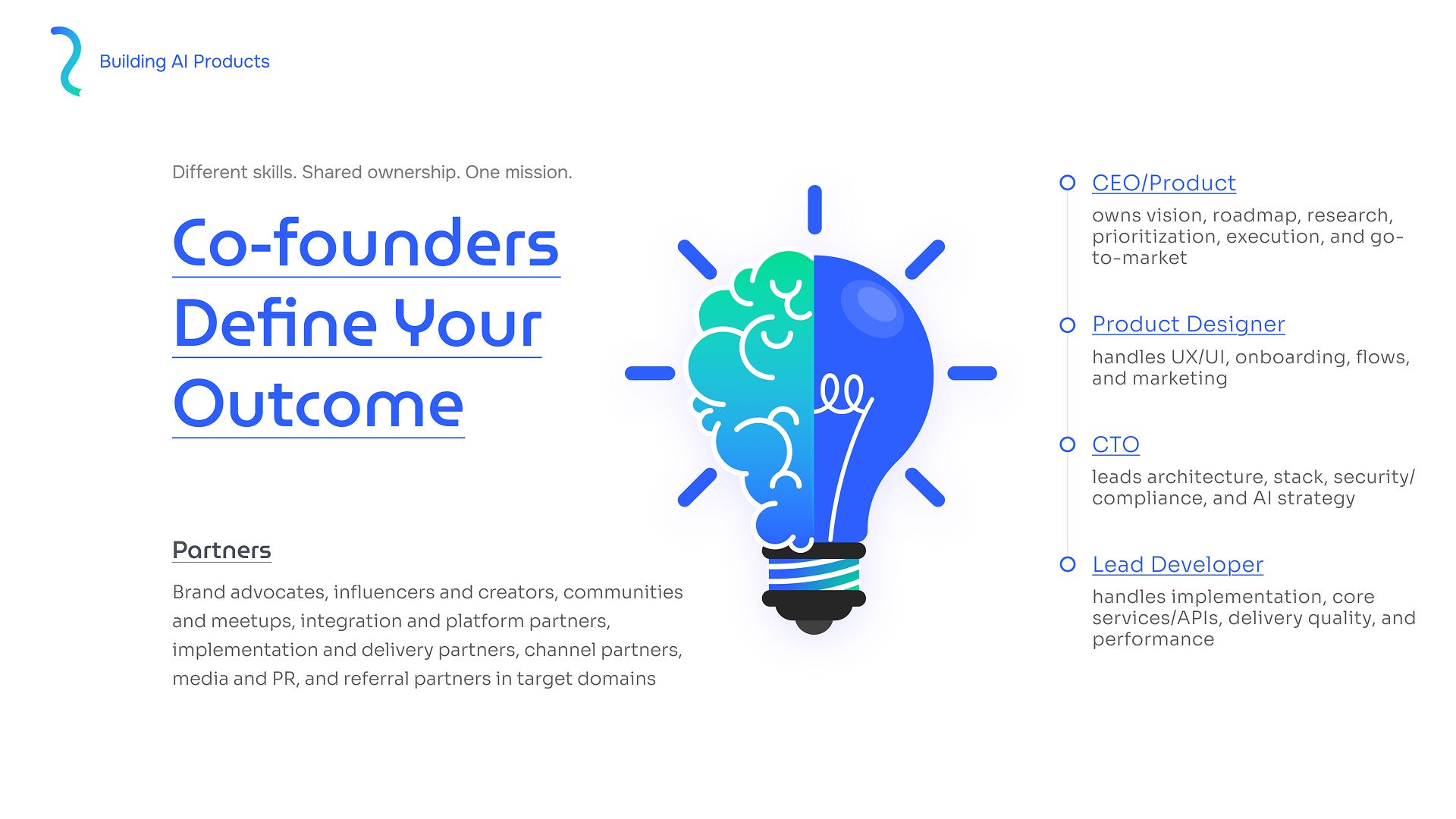
In our journey, there were four of us, each bringing strengths the others lacked. One drove product, taking responsibility for vision and execution. A designer owned experience and navigation: onboarding, UX/UI, and user workflow. On the engineering side, our CTO and Tech led architecture and technical direction.
When choosing co-founders, you should be very picky. Ask yourself: What can this person do for the company? Then make it clear how equity is split and who shares the responsibilities. Equal split or not, it must reflect the actual labor and risk. We split equally.
We learned that building a core founding team is necessary, but not enough. Powerful businesses also build networks of partners around them. A bench of early believers, from advisors to media influencers, business partners, and other agencies in different domains. Too often, teams wait until launch to seek this support. These partners open doors, validate concepts, and extend your team’s reach before any code ships.
If you’re sitting with an idea but unsure how to take the first step, focus here: assemble your co-founders. Be ruthless about complementary skills, align incentives from day one, and don’t neglect the extended community you’ll need to outlast the first wave of setbacks.
Start with the right people, and the odds begin to shift in your favor.
Lesson 2. Start with the problem: ideas don’t matter without pain
To be honest, we started with a solution. Why? Because one of our co-founders already had a solution; he was using it for personal purposes. As simple as that. We had a piece of technology that worked. And the instinct was to run with it, turn it into a product, and figure out the rest along the way. A typical founder’s mistake.
At the same time, we recognized the risks. There was a real chance this path could lead nowhere, that we might invest months only to discover there was no real demand. But if we were going to try, we owed it to ourselves to at least do it the right way. That meant starting from customer research.
We conducted user interviews, studied workflows, and looked for pain points that could anchor this technology. We found one: business professionals use between 7 and 15 apps daily, and a meaningful portion say they are frustrated by constant context switching. Good enough, we thought.
But down the road, as we dug deeper into the customer research and had deeper conversations with potential users, the picture shifted. Context switching was annoying, sure, but it was not the real pain. The problems that actually kept people up at night were far more specific and far more urgent:
AI missed the business context: 41% of users were dissatisfied with how irrelevant AI outputs felt to their actual situation.
Answers without execution: Users got information, but still had to do all the follow-up manually. No tasks were created, no workflows triggered.
Low trust in AI outputs: Without clear context and sources, people couldn’t rely on what the system told them.
Fragmented channels: Chats, emails, and meeting transcripts lived in separate worlds. Nothing connected the dots across communication tools.
No organizational awareness: AI had no understanding of roles, permissions, or team relationships inside a company.
See the gap? We assumed the problem was “too many apps.” The real problems were trust, execution, and missing business context.
This is the eternal product dilemma. Sometimes, the solution itself becomes the problem. You fall in love with what you built, and you start bending reality to justify it. You look for evidence that confirms the path you are already on, instead of evidence that challenges it.
Users don’t care about your technology. They do care about their problems. People buy products to ease pain, fulfill a need, or get a result they cannot get on their own. If your product does not connect to one of those, it does not matter how impressive the tech is.
Most startups fail right here. They ship what they can build, not what users need. We learned this the hard way. Our solution literally became our problem, because it locked us into a framing that did not match what the market actually needed.
So, define the right problem first, validate it with real evidence, and only then decide what to build.
Lesson 3. Understand before building: Market, users, and demand
A real problem worth solving is not the same thing as a viable business you want to build. Before a single line of code, you need to answer a simple yet tricky question: how big is this problem?
How big, in money, in users, in market structure. This is where most technical founders go quiet, because the answer requires a different kind of work. Not building, but researching and crunching numbers.
I learned this lesson in the most direct way possible. When I was pitching Meetia at the Founders Institute startup accelerator, investors asked me this question over and over: “How big is the market you are going after?” If you cannot quantify the opportunity, the conversation ends there. The truth is that, at the early stage, investors look for, above almost everything else, market size.
Why market size matters
Market size is not a slide in your pitch deck, it is your strategic compass. It tells you what game you are playing, how much room there is to grow, and whether the economics of your business can ever work at scale.
Here is what understanding market size actually gives you:
Investor attractiveness. Venture capital works on power laws. Investors need to believe your startup can become very large. If the addressable market is small, even perfect execution will not generate the returns that justify outside funding.
Competitive clarity. Sizing the market forces you to map the landscape. Who else is solving this problem? Where are the gaps? Are incumbents entrenched, or is the space still forming? It directly shapes your positioning, pricing, and go-to-market approach.
Willingness to pay. The most dangerous assumption in any startup is that users will pay for your solution just because they have the problem. Market research surfaces whether budgets exist, what price points the market tolerates, and who actually controls the purchasing decision. Without this, you are guessing with your business model.
Prioritization. When you understand the market's size and structure, you can make better decisions about which segments to target first, which features to prioritize, and where to focus limited resources for maximum traction.
When we evaluated the market for Meetia, we used the standard TAM-SAM-SOM framework.
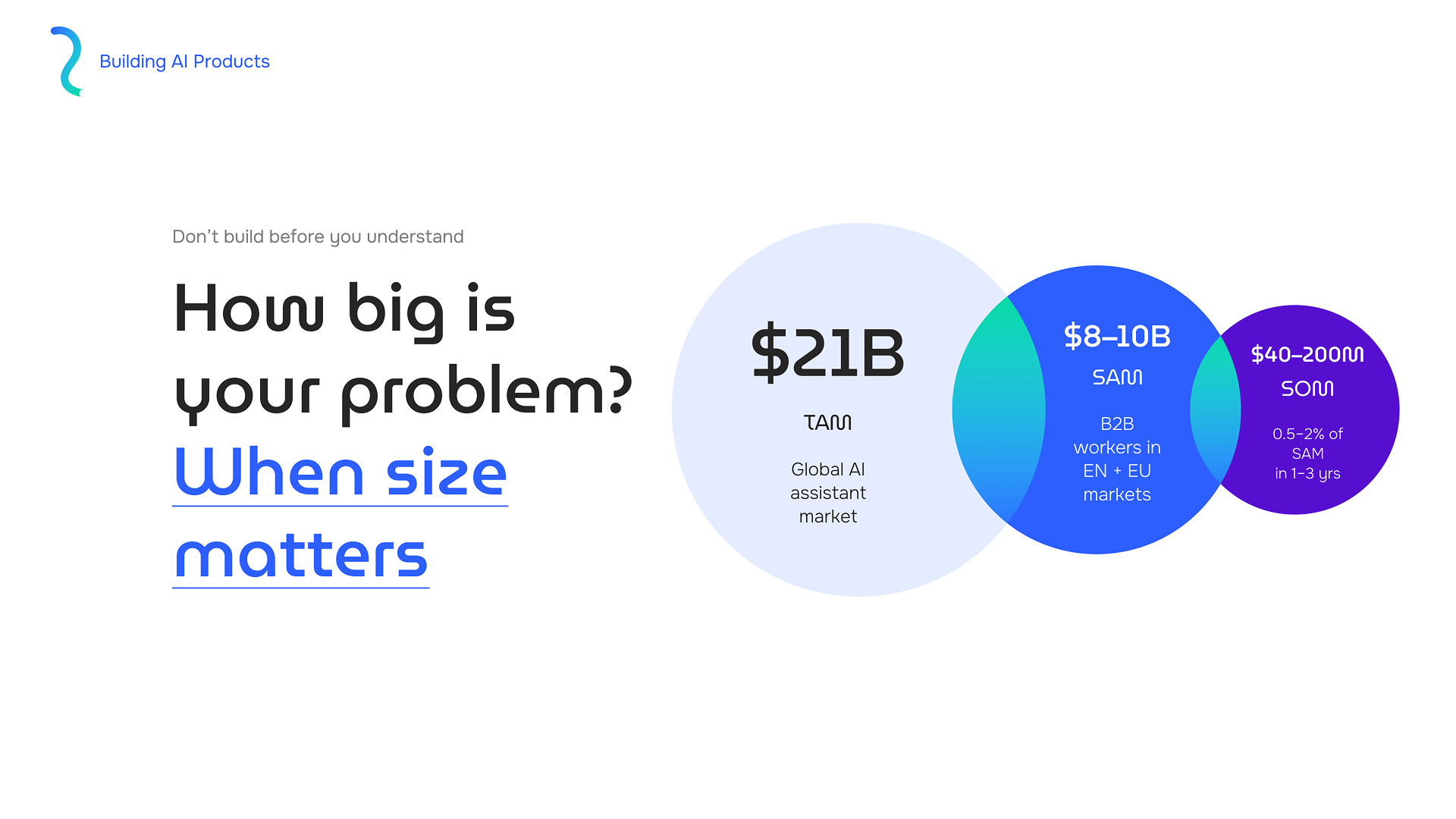
The global AI assistant market is projected to reach roughly $21 billion by 2030. That is the TAM, the theoretical ceiling if every potential customer adopted a solution like ours. No startup captures the TAM, but it tells you whether the space is big enough to matter.
Narrow the lens to B2B knowledge workers in English-speaking and EU markets, where our product and go-to-market could realistically operate, and you get a SAM of $8 to $10 billion.
A startup in years one to three can credibly capture 0.5 to 2 percent of its SAM. For us, that meant $40 to $200 million in potential revenue. This is the number that actually matters, because it is tied to your team, your sales capacity, and your runway.
After researching and evaluating, we had better picture who we were building for, how much they would pay, where the competition was weak, which shaped every decision that followed.
Important to note that real market evaluation is ongoing. It involves studying the competitive landscape, tracking how fast the market is growing and in which segments, understanding pricing models that work in your category, and continuously validating whether your assumptions still hold as the market evolves.
AI tools have made this dramatically faster. You can use them to synthesize analyst reports, model scenarios, aggregate competitive data, and pressure-test your positioning in hours rather than weeks. But the thinking still has to be yours. AI can accelerate research, but it can’t replace the judgment required to interpret what the data means for your specific situation.
Lesson 4. Design first: validate early, reduce risk
When founders think about their product, they picture the app and features.
Your application is not a product. That is only the visible layer. Your product is the full system of experiences surrounding the user. It starts the moment someone sees your ad or hears about you from a colleague. It continues through your landing page, signup, onboarding, core interactions, support, billing up to the day they decide to cancel. If you only design the app, and the rest happens by accident, likely users won’t stick.
Before we built anything for Meetia, we mapped the full product architecture. The entire customer journey, end to end, from first discovery to active use to potential churn. Onboarding was more complex than we assumed, certain AI interactions needed human control we had not planned for. All of this surfaced in design, not in production.
Once the journey was mapped, we built interactive Figma prototypes. Clickable, testable, and real enough to put in front of actual users to test our assumptions. You can also show prototypes to investors. A polished prototype communicates product vision far more effectively than a slide deck with bullet points. It demonstrates that you have thought through the experience, not just the technology.
Building Meetia, we realized that AI products carry risks traditional software does not. Large language models hallucinate, transcription engines mishear, summaries sound confident while being wrong. They are baseline behaviors of the technology, and if you do not design for them, your users will discover them in the worst possible moments. This is where human-in-the-loop design becomes critical. You need to define where the AI acts autonomously and where a human confirms or overrides. You need to build trust.
Designing first is the cheapest and fastest way to find out your product does not work, before you have written a single line of code. Design first is your risk management strategy. So, map out the full journey before you build anything. Prototype the experience and put it in front of real people. Design trust into every AI interaction, because your users will not trust what they cannot understand or control.
Lesson 5. AI is not magic: systems, infrastructure, business logic
At some point, every AI founder asks the same question: can we build a scalable product with AI alone? Without human developers.
When AI coding tools entered our workflow, the productivity gains felt almost unreal. Features that would have taken a week appeared in hours. For a brief moment, it genuinely seemed like the bottleneck of software development had been broken.
But generating code is not the same as building a product.
AI writes code. But it does not build systems. Your product is not just an application. It is infrastructure, integrations, payment flows, CRM connections, error handling, security, monitoring, and dozens of invisible layers that hold the whole thing together. AI can accelerate parts of this work. It cannot replace the thinking required to design, connect, and maintain everything underneath.
You still need infrastructure: how your services deploy, scale, and recover from failure. You still need integrations: every external system has its own quirks, rate limits, and failure modes. You still need control, especially in AI case: logging, monitoring, alerting, rollback strategies, security.
So, is it possible to build a scalable product with AI alone, without human developers, without knowing how to code? We say: no.
AI gives you the leverage, we shipped Meetia with two people that would have required six or seven without AI tooling. That advantage is real, but with a grain of salt. You still need people who understand why architectural choices matter, who can debug problems across systems, and who can make judgment calls when the AI-generated solution is technically correct but operationally fragile.
Lesson 6. Know your economics: AI cost shapes your business model
Our Tech Lead was pushing me to crunch the numbers from the very beginning. “We need to model the costs,” he kept saying. And he was right. But the honest answer was: we could not. Not yet.
We were still testing different models, swapping transcription providers, experimenting with AI stacks. The architecture was a moving target. Every week brought a new combination of LLMs, speech-to-text engines, and processing approaches. How do you calculate unit economics when the foundation keeps shifting underneath you? This is where the business meets the AI reality.
When you build an AI product, your costs are not like traditional SaaS. In a typical software product, your marginal cost per user is supposed to be close to zero. But in case of AI products, the economics of “build once, sell many” doesn’t work here. With AI, every interaction has a price tag. Every transcription minute, every prompt, every model call costs real money. And the more capable the model, the higher that price climbs.
We run two types of AI models in Meetia: a large language model for AI interactions and a speech-to-text model for transcription. Each has its own pricing curve, its own usage patterns, and its own way of eating into your margins. When we finally modeled the full cost per user across our pricing tiers, the numbers forced a serious conversation. Here is what our unit economics actually look like:
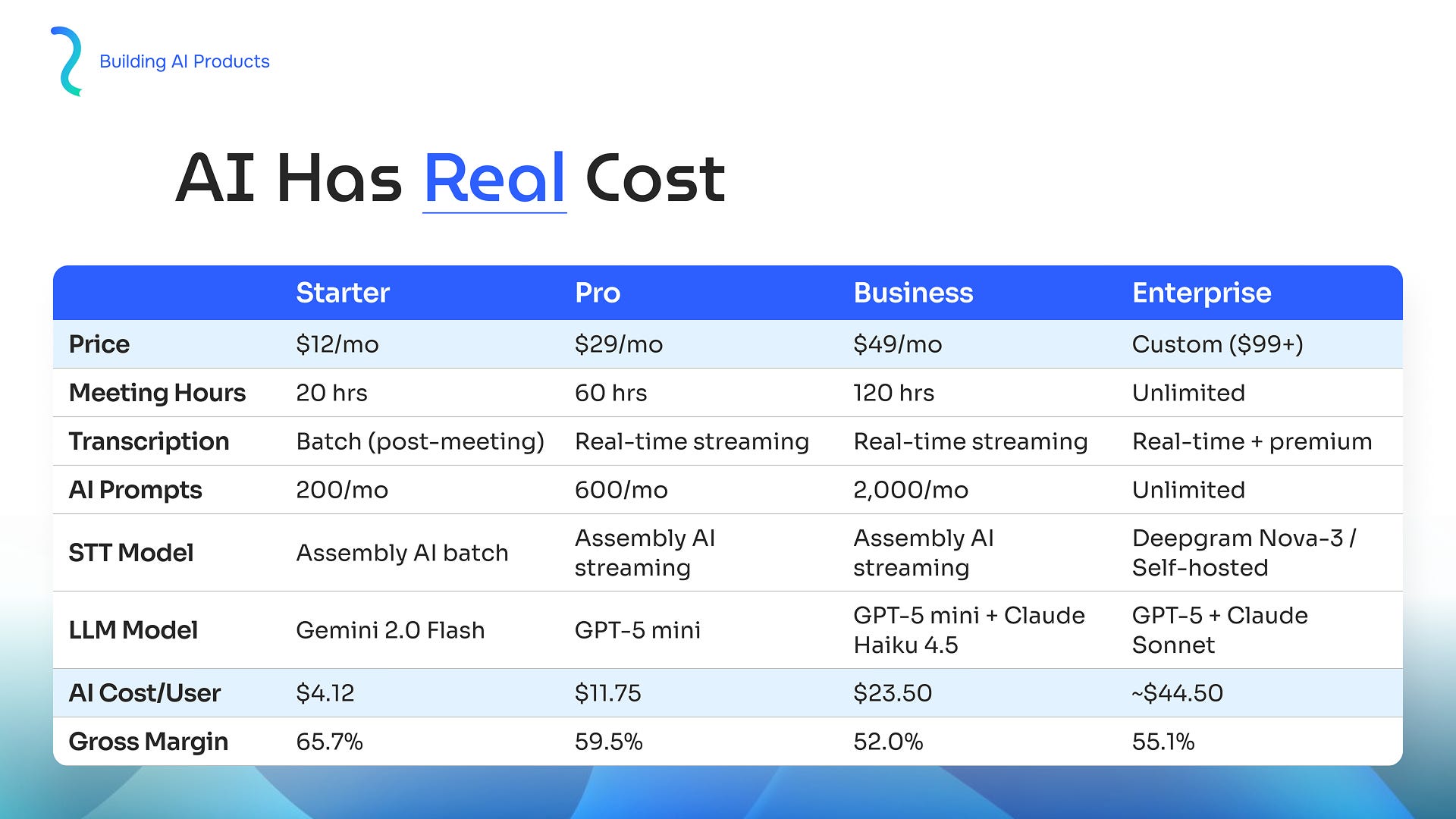
Our Tech Lead’s instinct was correct. We should have pushed harder to estimate these numbers sooner, even with rough assumptions. Because once we saw them clearly, three things stood out.
AI cost scales with capability, not just usage. The Starter tier uses a lightweight model (Gemini 2.0 Flash) and batch transcription. That keeps the AI cost at $4.12 per user, roughly a third of the price. Move to the Business tier with real-time streaming and more capable LLMs, and the AI cost jumps to $23.50. Almost half the $49 price tag, just for the models.
Your margins compress exactly where your product gets better. At the Starter level, gross margin sits at a healthy 65.7%. By the Business tier, it drops to 52%. The more powerful and useful the product becomes, the more it costs you to deliver.
These numbers do not include everything else like infrastructure cost, salaries, taxes, customer acquisition, or support. Layer those in, and a $49 price tag point starts to feel thin. The AI cost alone can make or break your viability, before you even account for everything else it takes to run a company.
This is the calculation most AI founders skip until it is too late. You prototype with a powerful model, fall in love with the output quality, and then discover that serving it at scale to paying users requires either much higher prices or much lower margins than your business plan assumed.
Simply put, AI cost defines the business model and architecture of your product. So, estimate your AI costs early, run the numbers with rough assumptions, and update them as things get clear. Because the worst time to discover your product is not viable is after you have already shipped it.
Lesson 7. Build community early: No users, no product
How do you get your first users? We learned that the answer has nothing to do with features. It starts with leveraging channels you already have. For us, that was our professional network on LinkedIn. The audience was already there, we just had to give them a reason to engage.
We started running polls, sharing progress, asking direct questions about the problems we were solving. The community responded, and gave us our first feedback, revealed problems we had not considered, and became our earliest base of support.
In a market saturated with similar AI tools, the product alone will not promote itself. What separates products that gain traction from the ones that fade away is distribution. And distribution, in its most durable form, is community.
A community does things no ad campaign or sales team can replicate. It validates your direction before you ship. It gives you feedback before you scale. It advocates for you in rooms you will never enter. Early users who feel ownership over your product become your most effective channel, because they do not just use it. They talk about it.
But community does not build itself. You have to show up, engage, and create value before asking for anything in return. Share what you are learning. Be visible where your future users already spend their attention.
The good news is that AI has made this more accessible. You can produce high-quality content at a pace that was impossible even two years ago. You can engage with influencers in your space, expand your media presence across platforms, and build thought leadership without a dedicated content team.
When you have an engaged audience, you have something far more valuable than a list of email addresses. You have a testing ground. Every new feature, every pricing experiment, every positioning shift can be validated with real people who already care about what you are building. You can iterate faster because feedback loops are shorter. You can test entirely new products targeted at specific segments of your audience, without starting from zero each time.
And when traction stalls, and you need to pivot, a community gives you something most startups do not have: a second chance. If people trust you, they will follow you into the next iteration.
So build your community early. Create content, show your process, engage where your audience already lives. Because no users means no product, no matter how good the technology is underneath.
Lesson 8. You are more than features: positioning, UX, and brand win
“What if they copy our product?”
This question came up in our team more times than I can count. You spend months building something, and then you look around and realize: someone with more money, a bigger team, or a faster release cycle could just replicate your features. What then?
Yes, they can copy, and they will for sure. In AI especially, where so much of the underlying technology is commoditized, the distance between “our product” and “their clone” can shrink to weeks. If your entire competitive advantage is a set of features, you are standing on vague ground that is already shifting.
They can copy features, but nobody can replicate your brain. They can be screenshotted, reverse-engineered, rebuilt. But the way you frame the problem you solve? The way you position the product in a market? The messaging, the wording, the brand you build around it? That is yours. It lives in your decisions, your taste, your understanding of your user. No competitor can copy that, because they did not earn it the way you did.
There are dozens of AI assistants, so what is the point of building another one? Simply because, you can always do it better. Better UX, better pricing, faster performance, sharper value proposition combined into a thoughtful onboarding flow. You can build a brand that speaks to a specific audience in a way that catches them.
So when the fear creeps in, do not try to out-feature the competition, out-think them. Sharpen your positioning, refine onboarding, build a brand that speaks to your audience.
Lesson 9. Change direction when needed: no traction means adjust
Yes, pivoting feels like failure. We have been building, iterating, pushing through obstacles, but numbers remained flat. The market is not responding the way we expected. We need to change direction, to pivot.
The word “pivot” carries unnecessary weight. It sounds dramatic, like the end and starting over. However, it is simply a course correction. It is taking what you have learned, what you have built, and what the market is telling you, and adjusting your approach based on evidence instead of hope and believes.
Most founders resist this for too long, as we did. We need more time, more features, a better landing page. But when you have been at it for months and didn’t get any traction, the problem is rarely execution. Likely, your product, positioning, or audience is off. And no amount of polishing will fix a fundamental mismatch.
We learned that there are many ways to change direction without abandoning what you have built.
Reposition the product. Same technology, different framing. You change how you describe the product, what problem you lead with, and who you speak to. This is the lightest pivot, and often the most underestimated. A product that fails to resonate with one audience can land perfectly with another, just by shifting how you communicate its value.
Change the target audience. Your product might be strong, but aimed at the wrong buyers. Moving from B2C to B2B, or from startups to enterprise, or from individual users to teams can unlock entirely different economics and demand patterns. The product stays largely the same. The go-to-market changes completely.
Narrow or shift the use case. Instead of being a general-purpose tool, you zoom in on a specific workflow or pain point where your product delivers the most value. This is often where startups find their first real traction, not by doing more, but by doing one thing exceptionally well for a specific group.
Adjust the business model. Sometimes the product-market fit is there, but the monetization is wrong. You might need to move from subscription to usage-based pricing, offer a freemium tier, or restructure your packaging entirely. The product stays, the economics change.
Rethink the channel. You could have the right product and the right audience, but the wrong distribution approach. Switching from outbound sales to content-led growth, or from direct sales to partnerships, can change traction overnight.
We are going through this ourselves. Meetia was initially positioned for individual users, a B2C play. But the economics did not hold up. The product was too robust, too expensive per user to compete with lightweight consumer alternatives. So we shifted the primary target audience. We are now repositioning Meetia as a virtual AI-driven workspace for businesses, leaning into what B2B buyers actually care about: security, control over AI usage, and organizational awareness. We are actively researching potential B2B partners, studying the market for gaps we can fill, and having conversations to understand their specific pains and workflows. It is the same technology, reframed for a different buyer with different priorities. That is what a pivot looks like.
But pivoting without a method is just guessing in a new direction. This is where experimentation becomes critical:
Run small experiments before making a full commitment.
Reach out to ten potential customers in the new segment and ask specific questions about their workflows.
Build a lightweight landing page with the new positioning and see if it generates interest.
Offer a limited pilot to a handful of companies and measure engagement, not just sign-ups.
The founders who struggle most with pivoting are the ones who see it as admitting defeat. We learned that pivoting is the most rational thing a founder can do when the evidence says the current path is not working. So if traction has not arrived, do not wait for it to appear: change, validate, and move forward magically.
Thanks for reading!
I hope these lessons help you avoid some of the mistakes we made.
If you’re building an AI product, I’d love to hear what you’re working on.